
 Visit our Showsite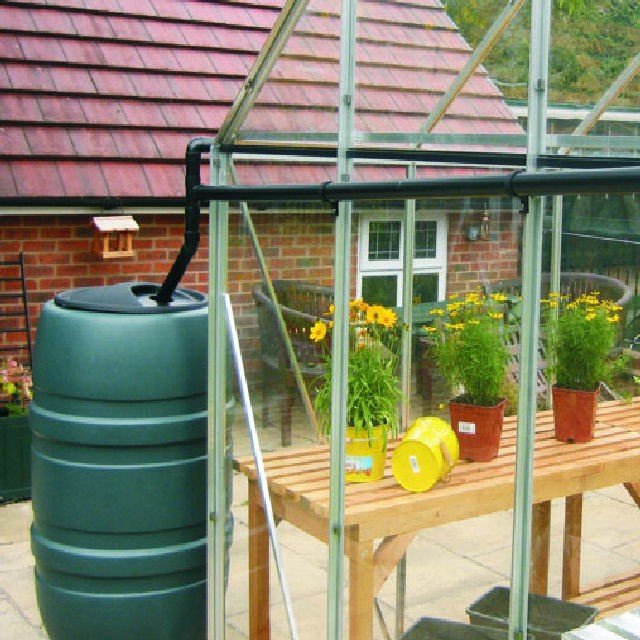
Product Code - 70011043
Usually delivered: 3-5 Working Days.
Description
Recycling rain water is an intelligent gardening tip as plants thrive and flourish form natural rain water compared with tap water. Elite are famed for their unique integral semi-circled gutters and are the only manufacturer in the market place to adopt this style. The Elite Rainwater Kit to One Gutter is suitable for all Elite Freestanding Greenhouses. Key Features of the Elite Standard Rainwater Kit for Freestanding Greenhouses
- Suitable for freestanding greenhouses
- By collecting at one point saves space as only ONE water barrel is required (Not Included)
- Supplied with all fixtures, fittings and downpipe
Product Description
To eradicate the need for more than one barrel or outlet, a traverse pipe is placed along the rear of the greenhouse terminating into a T-Junction which connects both gutters to one outlet. This in turn allows the water to be carried from both gutters into a single point such as a barrel or grid. Hence only an Elite rainwater kit, finished in matt black PVC with UVI protection will fit these special gutters. When ordering we need to know the greenhouse width.
Please Note: There are two options for the Elite Rainwater Kit to One Gutter, for Greenhouses up to 8' Wide and Greenhouses up to 12' Wide
About Elite
Elite Greenhouses has been established for over 50 years and boasts a considerable reputation for quality and service which is hard to match. The values of Elite have not changed over the years their formula is simple and instilled throughout their range. They continue to produce a lifelong greenhouse and accessories, born from experience and manufactured with pride. Elite have the broadest range of greenhouses and greenhouse accessories, a distinct product, in the widest of optional colours. All Elite Greenhouse components confirm to British Standards.
Please note: some images may show the Rainwater Kit with accessories/furnishings/ the greenhouse these are for display purposes only and they are not included with your purchase.
Disclaimer: The Water Barrel and Stand are only provided and sold separately alongside the purchase of an Elite Greenhouse.
Delivery
ALL DELIVERIES ARE DELIVERED TO KERBSIDE OR DRIVEWAY, PRODUCTS ARE DELIVERED FLAT PACKED READY FOR ASSEMBLY
Delivery
Delivery is between 7am to 7pm. Your order is a kerbside or driveway delivery. Your order will be delivered by a courier therefore you will not be contacted with a prior delivery date. If you are not in on the day of the delivery you will be carded and asked to contact the courier to arrange a new mutual delivery date.
Delivery Leadtimes
The estimated delivery lead time for this product is identified on the product page above. Lead times are in working days (Monday ? Friday) excludes Bank Holidays. These estimated lead times are provided by the manufacturers and are not guaranteed - due to fluctuation in demand - but are provided in good faith and are representative of delivery at that time. Some remote areas will take a little longer.
Quickview
Specially designed for Elite Greenhouses. Allows the use of one water barrel.
-
- Only One Water Barrel is required (Not Included)
- Includes fittings and downpipe
Description
-
- Only One Water Barrel is required (Not Included)
-
- Includes fittings and downpipe
Customer Reviews